

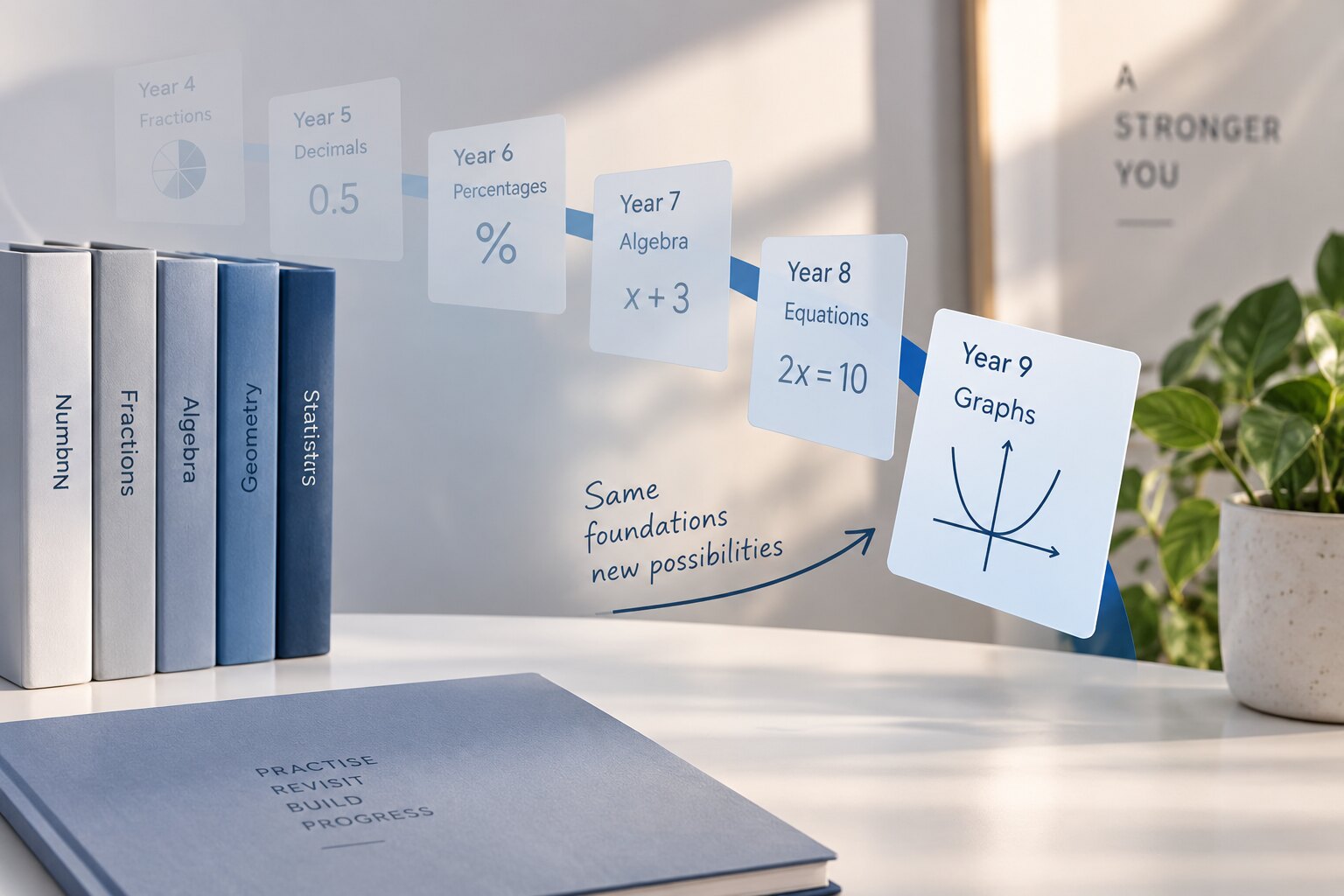
Forgetting something you genuinely understood is not a sign that you never understood it. It is what happens to almost everything you learn unless you go back to it. The uncomfortable part is that the best moment to return to a topic is after you have started to forget it, not while it still feels fresh, which means effective revision feels harder and less satisfying than ineffective revision.
Maths punishes forgetting more heavily than most subjects, for two reasons worth understanding.
1. Everything Is a Prerequisite for Something
Maths content stacks. Equivalent fractions from Year 4 sit underneath adding fractions with different denominators in Year 6, which sits underneath algebraic fractions later on. Multiplication facts sit underneath division, factors, simplifying, ratio and most of what you will do at GCSE.
When an earlier layer decays, the damage does not appear where the decay happened. It appears two years later in a topic that seems unrelated, and it looks like being bad at that new topic. Students conclude that they cannot do ratio. Usually they can do ratio and cannot reliably divide.
2. No Exam Question Tells You What It Is About
In a lesson on Pythagoras, every question is a Pythagoras question. You never have to work out which method applies, because the chapter heading has told you.
Exams remove that. A question about a ladder against a wall does not announce itself, and the first thing you have to do is recognise what kind of problem it is. That recognition is a separate skill from the method, and it is only trained by practising topics mixed together. If every set of questions you ever do is on one topic, you are practising half the task.
This is why students who score well on end of unit tests can be caught out by a full paper. The unit test did the recognition for them.
3. What to Do Instead of Rereading
Rereading notes is the most common revision method and one of the least effective. It produces a strong feeling of familiarity, which is easily mistaken for knowing something.
Three approaches do more, all of them variations on making yourself retrieve rather than review.
Answer before you look. Close the book, try to do the question, then check. The struggle to recall is the part that strengthens the memory. Reading a worked example first and then doing a similar question mostly trains copying.
Mix the topics up. Do a set of ten questions drawn from five different topics rather than ten from one. This is harder and feels worse, and it trains the recognition skill that single-topic sets cannot.
Come back after a gap. Revisit a topic a week later, then a month later, rather than three times in one evening. Retrieval practice, spacing and interleaving are all among the approaches examined in the Education Endowment Foundation’s 2021 review of cognitive science in the classroom, which found them promising while noting that the evidence about applying them well in real classrooms is thinner than the enthusiasm for them.
4. Running a Rotation Without Turning It Into a Project
Keep a list of every topic you have covered this year. Each week, pick two or three at random and do a few questions from each. When one goes badly, move it into the current topic slot for a few days. When it goes fine, put it back in the rotation.
That is the whole system. It takes about five minutes a session, and it is the difference between arriving at an exam with a year of maths available to you and arriving with the last six weeks.
If you are wondering how to fit this into a weekly routine, how often should you practise maths sets out the session structure. To find out which older topics are actually weak rather than guessing, a Module Assessment on a topic you have not touched for months will tell you quickly.