

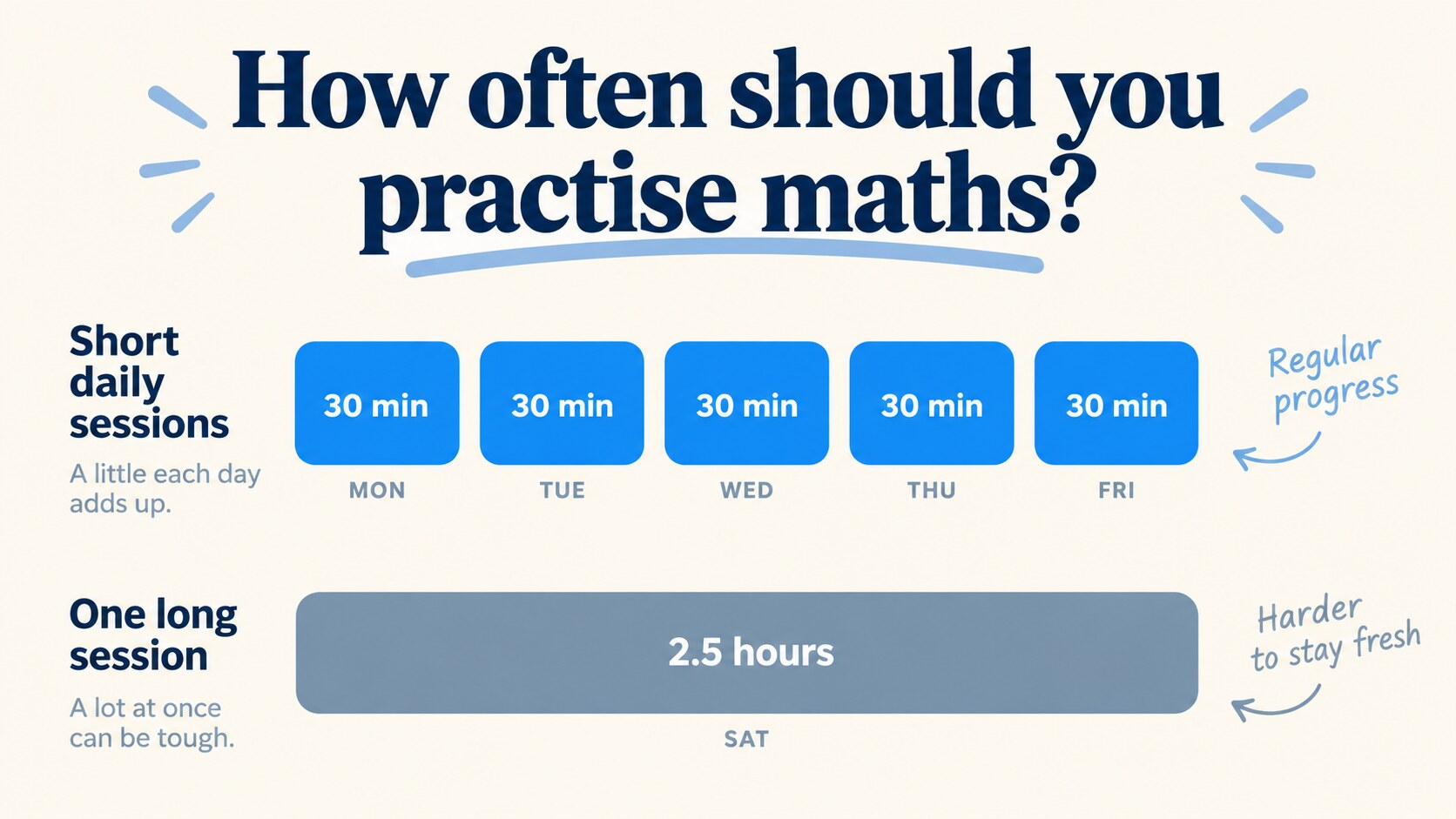
Four or five short sessions across a week will do more for you than one long session at the weekend, even if the long session adds up to more total minutes. Twenty to thirty minutes is enough for a useful session. Beyond about forty minutes, most people are still sitting there but no longer learning much.
The reason is not willpower. Learning that is spread out over time is retained better than the same amount of learning packed into one sitting, and spaced learning is one of the approaches the Education Endowment Foundation identified in its 2021 review of cognitive science in the classroom. The review is careful about how well these findings transfer into real classrooms, so treat the size of the effect as uncertain and the direction as reliable. Spreading practice out is not a trick. It is just how memory behaves.
1. What a Session Should Contain
An hour of doing thirty questions on the same topic feels productive and teaches you less than you think. A better shape for twenty-five minutes looks like this.
- Five minutes on facts. Times tables, number bonds, squares, conversions, whatever you are still slow on. Speed here buys you attention everywhere else, because a calculation you have to work out is a calculation that occupies the part of your brain you need for the actual problem.
- Fifteen minutes on the current topic. Whatever is being taught now, or whatever you got wrong most recently.
- Five minutes on something older. Two or three questions from a topic you did months ago, chosen more or less at random.
2. The Five Minutes People Skip
That last five minutes is the part people skip, and it is the part that stops this year’s work quietly disappearing. There is a separate piece on why revisiting old maths topics matters if you want the reasoning.
3. How to Tell Whether You Are Doing the Right Amount
Judge it by what happens in the session, not by the clock.
If you are getting nearly everything right, the practice is too easy and you are rehearsing rather than learning. Move up a difficulty level or find a mixed set.
If you are getting nearly everything wrong, you are missing something earlier and no amount of repetition will fix it. Stop and go back to the previous skill.
If you can feel your attention going after fifteen minutes, stop at fifteen minutes. A session you finish while still concentrating is worth two you push through in a fog, and it makes tomorrow’s session more likely to happen.
4. Exam Periods Are Different, but Not as Different as People Think
In the run-up to an exam the balance shifts towards full past papers under timed conditions, because timing and stamina are separate skills that need their own practice. What does not change is the frequency. Four ninety-minute papers across a week beats one six-hour Sunday, for the same reason as everything else on this page.
What genuinely changes is the ratio of practice to review. During normal term time, most of your session is doing questions. In exam preparation, at least a third of the time should go on working through what you got wrong, because a paper you mark and abandon has taught you almost nothing.
5. The Version That Survives Contact With a School Week
Ambitious schedules collapse. Set the floor low enough that you will hit it on a bad day: fifteen minutes, five days a week, non-negotiable, plus more when you have time. A schedule you keep at sixty per cent intensity beats a schedule you abandon in a fortnight.
Daily Practice is built around this shape, with a short mixed set each day rather than a long block on one topic. If you know the specific thing you are weak on, the year group pages let you go straight to that skill and practise it.