

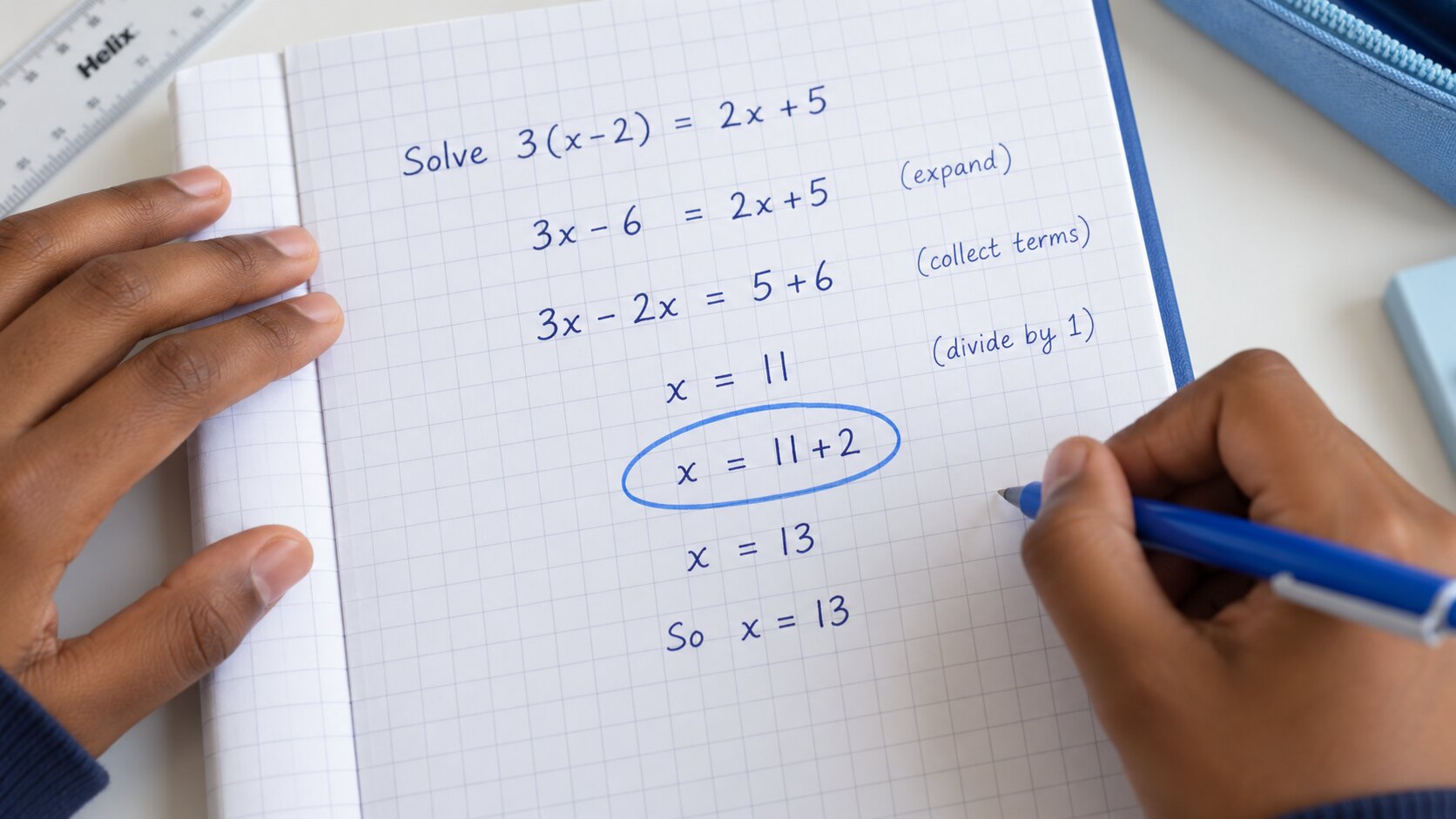
Watching a teacher work through a problem and following every step is recognition. Doing it yourself from a blank page is recall. They feel almost identical at the time, and they are not the same skill. The sensation of understanding while someone else does the work is not evidence that you can do the work, which is why lessons can feel clear and homework can go badly an hour later.
That is the general answer. The useful part is working out which specific thing is going wrong, because “I keep getting them wrong” covers at least five different problems with five different fixes.
1. Find Where the First Wrong Line Is
Before anything else, change how you check your work. Most people look at the final answer, see that it is wrong, and either redo the whole thing or give up.
Instead, go through your working line by line and find the first line that is wrong. Everything before it was fine. The error is in the step between that line and the one above it, and that step is the thing you need to fix. This takes two minutes and turns a vague failure into a specific one.
2. The Five Ways It Usually Goes Wrong
Each kind of mistake looks different on the page, and each has its own fix.
| What happened | How to recognise it | What fixes it |
|---|---|---|
| You misread the question | Your working is competent but answers a different question. You found the area when it asked for perimeter, or gave x when it asked for the angle. | Read the question, do the maths, then read the question again before writing the answer. |
| You could not start | The page is blank or you wrote something and crossed it out. You do not know which method applies. | This is a recognition problem, not a method problem. Practise mixed sets, and build a habit of asking what type of problem this is before touching it. |
| The method was right, the order was wrong | You used the correct approach but applied the steps out of sequence, or skipped one. | Write the steps out as a list once, from memory, without a question in front of you. If you cannot, the method is not secure yet. |
| The method was right, the arithmetic slipped | A times table fact, a sign error with negatives, a misplaced decimal point. The maths was fine, the calculation was not. | Fix the underlying fact recall. This is the most common cause and the easiest to ignore because it feels like carelessness. |
| Right value, wrong form | Correct number but not simplified, wrong units, rounded incorrectly, fraction left as improper when a mixed number was asked for. | Almost always fixed by rereading the question at the end. It costs marks in exams out of all proportion to the effort of fixing it. |
3. Sort Your Last Few Pieces of Work
Look back through your last few pieces of marked work and put each error into one of these categories. The distribution is usually lopsided, and whichever row has most of your errors in it is what you should be working on. It is rarely the topic itself.
4. The Sign Error Problem Deserves Its Own Paragraph
If a large share of your mistakes involve negatives, that is not carelessness and it will not be fixed by being more careful. It is an unresolved gap in how negative numbers behave, usually dating back to when they were first introduced, and it will keep costing you marks in algebra, in coordinates and in anything with a gradient until it is dealt with directly. Spend an hour on negatives specifically rather than another hour on the topic where the errors are showing up.
5. Redo, Do Not Just Review
When you get a question wrong and see the correct solution, you have not yet learned anything. Reading a correct solution produces the same false sense of understanding as watching the lesson.
Do the question again, from blank, the next day. If you can, the fix has landed. If you cannot, you had understood the explanation and not acquired the skill, which is exactly the situation this whole page is about.
If a particular method keeps collapsing, going back to a Quick Lesson on it and then straight into practice on the same skill from its year group page is more efficient than grinding through more mixed homework. And if you are unsure whether you have actually fixed something, how to know when you really understand a maths topic sets out four ways to test it honestly.