

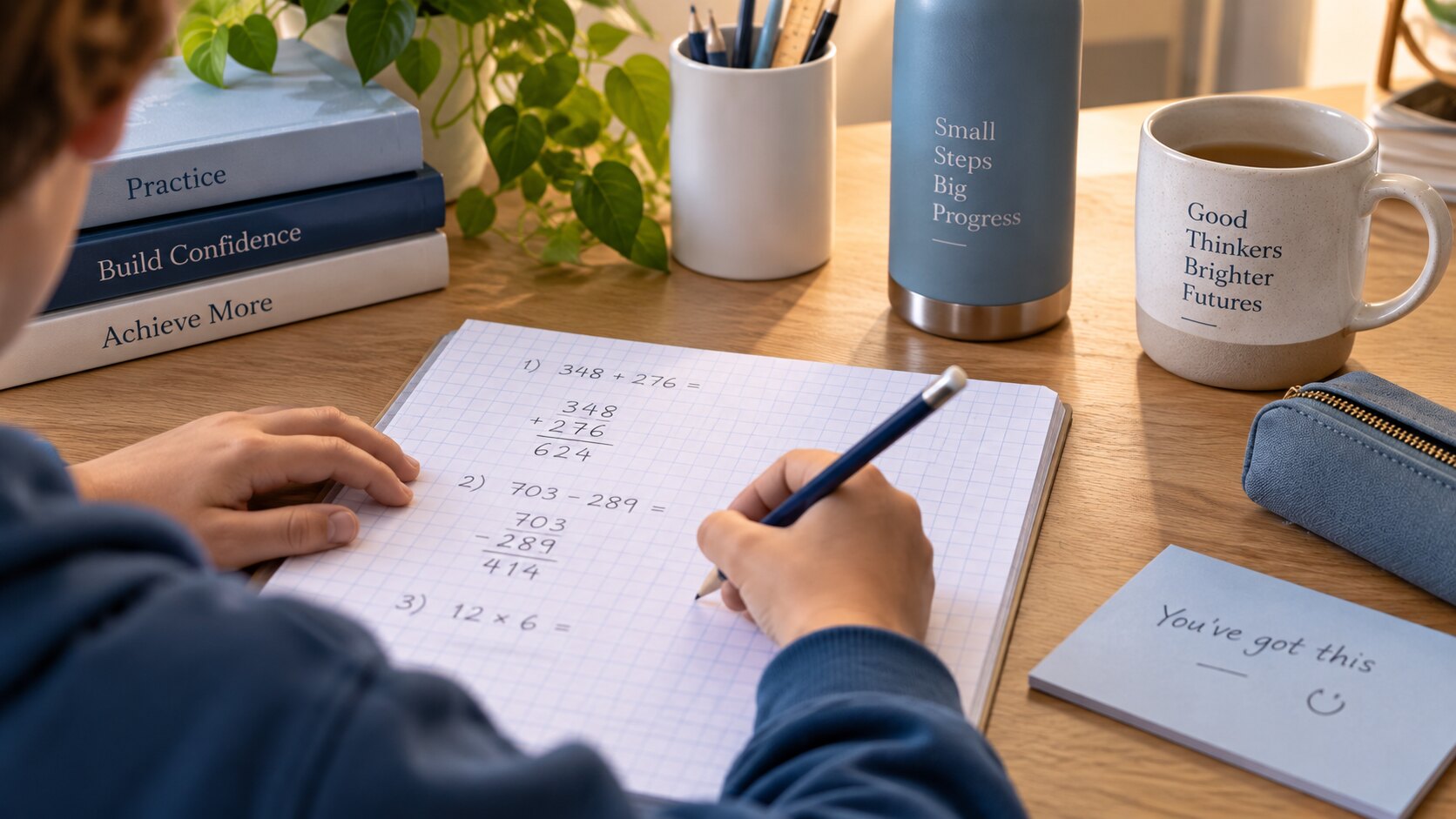
The most useful thing a parent can do with maths homework is refuse to explain it. Not out of principle, and not because you cannot, but because the explanation is rarely what the child is missing, and a second explanation from a second source in a second method is often actively unhelpful.
Your role is narrower than teaching and more valuable than it sounds: keep the working conditions right, ask questions that get the child unstuck without doing the thinking, and pass accurate information back to the teacher.
1. Why Your Method Causes Trouble
If you learned long division in the 1980s or 1990s, or learned it outside England, you were almost certainly taught a different written layout from the one your child is using. The same applies to multiplication, to subtraction, and to almost everything involving fractions.
The national curriculum sets out particular formal written methods, and schools build towards them deliberately across several years. A child part way through securing one method who is handed a competing one does not end up with two options. They usually end up with a hybrid that produces wrong answers and cannot be debugged by anyone.
If your child is stuck on the method itself, the fix is to get them back to their method rather than to supply yours. Their exercise book almost always contains a worked example from the lesson. Finding it together is a legitimate and useful thing to do.
2. What to Say When They Are Stuck
Four questions cover most situations, and none requires you to know how to do the maths.
- “What is the question actually asking for?” A surprising proportion of stuck moments are comprehension rather than maths. Getting the child to say what they are being asked to find, in their own words, resolves it more often than you would expect.
- “Roughly what should the answer be?” Estimation forces engagement with the size and meaning of the numbers. It also gives them something to check against, which catches slips they would otherwise hand in.
- “Have you done one like this before?” This sends them to the worked example rather than to you, and builds the habit of using their own book as a reference.
- “Show me the first bit you are not sure about.” Not the whole question, the first uncertain step. This narrows a vague “I don’t get it” into something specific, which is also exactly what the teacher needs to hear.
3. Knowing When to Stop
If none of these move things along after a few minutes, stop. Set a time limit on homework and hold it. Twenty to thirty minutes for primary, longer for secondary, but with a firm end. When the time is up, stop wherever you are, and write a short note to the teacher saying what was attempted and where it broke down.
This feels like giving up. It is the opposite. A teacher who receives three unfinished questions with a note saying “he could not get started on the ones with mixed numbers” has been handed precise diagnostic information. A teacher who receives a completed page finished at 9pm with heavy parental input has been handed misinformation, and will teach the next lesson on the basis of it.
Finishing the homework is not the objective. Accurate information about what the child can do is the objective.
4. Things Worth Doing That Are Not Teaching
A few habits do more for a child’s maths than any explanation at the kitchen table.
- Protect a short regular slot rather than long occasional sessions. Consistency does more than duration.
- Keep number facts ticking over. Multiplication facts up to 12 × 12 are expected by the end of Year 4, and they underpin fractions, ratio, division and most of secondary maths. Recall practice needs no explanation from you at all, and can be done in the car.
- Be careful how you talk about your own maths. “I was hopeless at maths” is offered as reassurance and lands as permission.
- Do not mark their work. Checking answers is useful. Grading them at the kitchen table turns homework into an assessment and removes the honest attempt.
5. When You Want More Than Questions
There is a point at which a child genuinely does need the topic explained again, and the parent is not the right person to do it. What they need is the same method the school uses, explained slowly, available to be replayed.
Ivy Maths Quick Lessons are built for that moment, so the explanation your child gets at home matches the one they had in class. Check My Homework is for the other common situation, where the work is done and neither of you is sure whether it is right.