

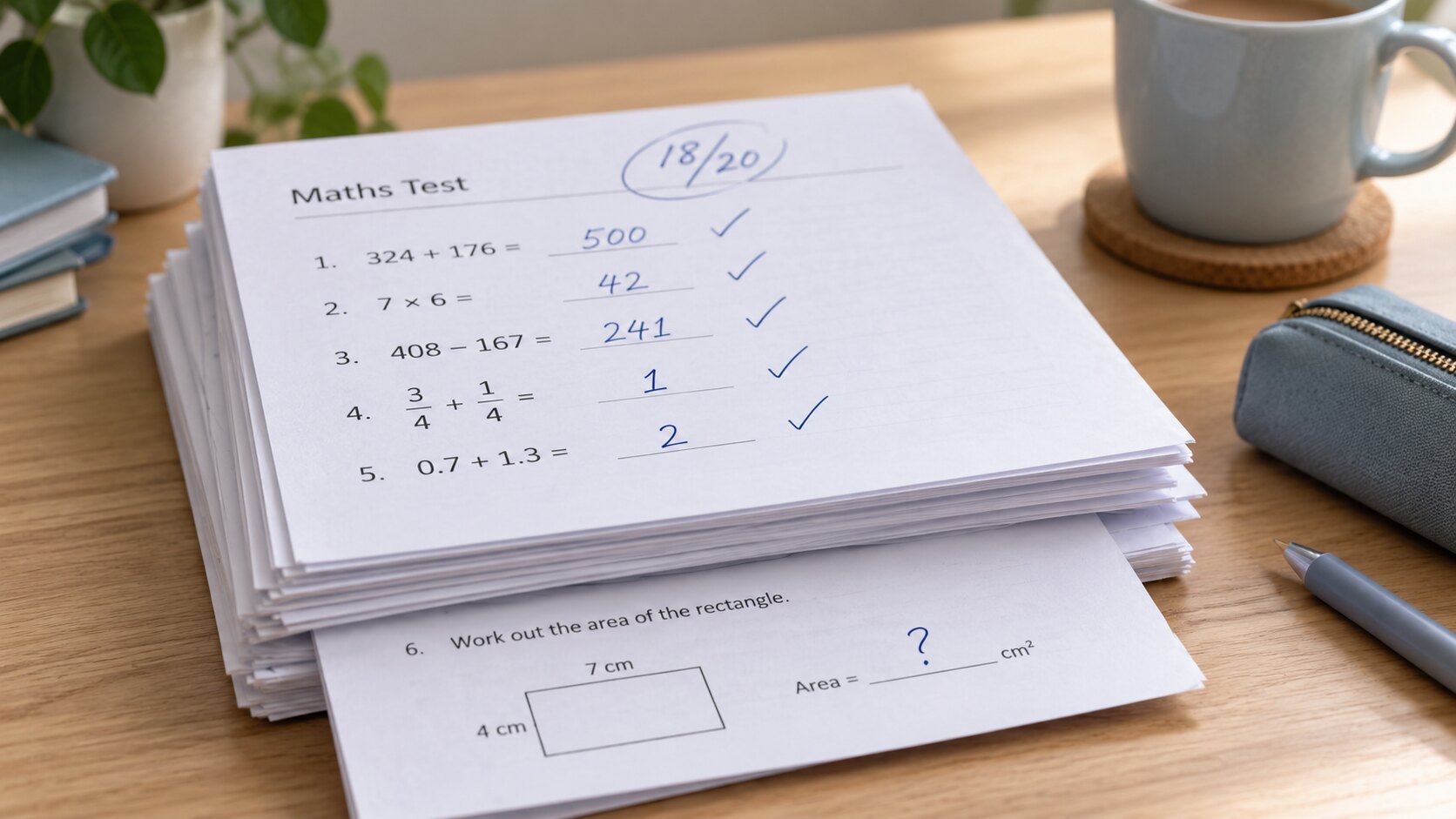
Most school maths tests are taken at the end of a block of teaching on that topic. That single fact explains most of the mystery. A test sat in the week after two weeks of fractions measures how well a recently practised method has been retained for a few days, under conditions where the child already knows the question is about fractions. It is a fair measure of that. It is a poor measure of whether fractions have been understood well enough to survive six months and turn up unlabelled in a longer paper.
Parents usually notice the discrepancy at a transition point. The child had consistently good marks through Years 4 and 5, then found Year 7 hard. Or scored well all through Year 9 and then struggled with the first full GCSE paper. Nothing changed about the child. What changed was the assessment.
1. Knowing the Method and Understanding the Maths Are Different Achievements
A child can execute a procedure accurately without knowing what it does. Both look identical on a marked page.
Take a Year 6 pupil who reliably gets that three quarters divided by 2 is three eighths. Ask why the answer is smaller than the number you started with, and you find out whether there is anything underneath the procedure. Or take column subtraction: a child who can produce the right answer to 4003 − 1856 but cannot say roughly what it should come to before starting has a place value problem that the correct answer conceals entirely.
This is not a failure of teaching. Procedures are taught because they work and because fluency with them frees up attention for harder things. The issue is that a test of the procedure and a test of the understanding look the same from the outside, and it is usually the procedure being tested.
2. Why the Test Itself Does Half the Work
When a child sits a test on percentages, they already know it is about percentages. That single piece of information removes the hardest step in most maths problems, which is deciding what kind of problem it is.
Several other features of a topic test lean the same way. The numbers in the questions tend to resemble the numbers in the examples worked in class. Method marks reward a recognisable approach even when the final answer is wrong, which is right and fair but means a mark can reflect an imitated method. And the whole thing is sat while the topic is at its freshest.
Change any of those conditions and the mark can move sharply. A mixed paper in July covering the whole year is a genuinely different assessment from six topic tests averaging the same score.
3. Where the Gap Becomes Visible
The pattern is fairly consistent. Marks hold up while assessment stays close to teaching, then drop when assessment moves away from it. The common trigger points are these.
- The Year 7 baseline test, set by a secondary school that has no stake in the primary judgement.
- Any end of year paper that samples the whole year rather than the last unit.
- The first topic that has a hard prerequisite, for example algebra requiring secure negative numbers, or ratio requiring secure multiplication and division facts.
- GCSE past papers, where no question announces its topic.
4. What a Parent Can Reasonably Conclude
None of these creates the gap. They reveal one that was already there, which is why the drop feels sudden even though the cause is not.
Good marks are genuine information. They tell you the child is engaging with lessons, retaining what is taught in the short term and applying methods accurately. That is worth something and it is worth saying to the child.
What they do not license is the assumption that everything below the current year is secure. If your child’s marks are strong and something still feels wrong, trust the observation. The usual next step is to look at older content rather than harder content, and to test it in conditions that do not tell the child what the topic is.
How to identify gaps in your child’s maths knowledge sets out how to do that, including how to trace an error back to the year group where the underlying skill was introduced.